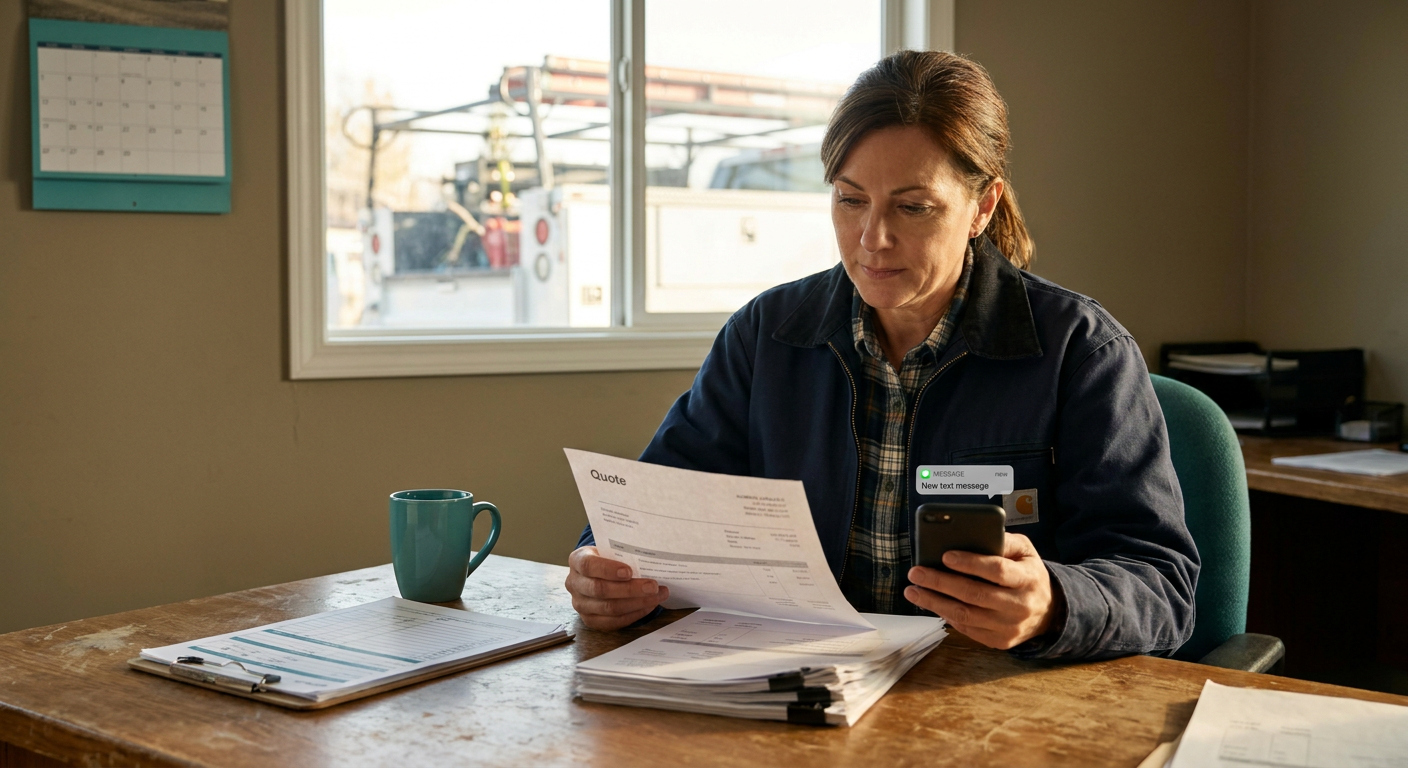
The Quotes You Already Sent Are Worth More Than New Leads
You sent the estimate. You showed up, measured, priced it right, and hit send.
Then nothing.
That silence used to mess with my head. Was the price too high? Did they go with someone cheaper? After enough of those, most owners shrug and move on. I get it. Chasing new business feels like progress. Waiting on an old quote doesn't.
But here's what I kept getting wrong.
The people who asked for your quote are already warm. They raised their hand. They know your name. You did all the hard work. And then you left it sitting there.
Research from Level CFO shows lost quotes go unanswered for an average of 29 days. Won quotes close in about 2. That gap isn't luck. It's follow-up.
The fix isn't complicated. Most businesses just aren't doing it.
Why Quotes Go Cold
It's rarely price.
You've probably assumed a quiet quote means the customer found someone cheaper. Sometimes. But Contractor Accelerator puts it plainly: "Contractors don't lose jobs on price. They lose them because they never follow up."
Here's what actually happens after you send an estimate.
The customer gets busy. Life comes up. They meant to call back. Or they're comparing two or three companies and you're not top of mind. Maybe they had a question but felt awkward reaching out first. Maybe they just... forgot.
None of those are "no." They're "not yet."
Level CFO's 7-day rule says quotes over $5K need a touchpoint within seven days. Most go untouched for nearly a month. By then, a competitor who followed up three times has the job.
How Many Follow-Ups Does It Actually Take?
More than you think.
Contractor Accelerator's research shows it takes 5 to 12 follow-ups to close a quote. The average business follows up once or twice. Then stops.
Five to twelve. Stop at two and that job is gone.
And no, that's not about being pushy. It's about not giving up on work that's already half-sold. Here's what a simple follow-up sequence looks like in practice:
Day 1. Confirm it arrived. Short text: "Hey, just making sure you got the estimate. Any questions?"
Day 4. Low-pressure check-in. Something like: "Happy to walk you through it or change anything."
Day 7. Ask for a decision. Try: "Ready to move forward, or do you need more time?" Makes it easy either way.
Day 14. Keep the door open. "Quote's still good. We've got time in the schedule if you want to lock it in."
Day 30. Last one. "Checking in before I close this out. Still interested?"
Five touchpoints. That's it. And the data says it's the bare minimum that actually closes jobs.
The businesses running this sequence close quotes their competitors already gave up on. Those jobs don't show up in your pipeline. They show up on someone else's invoice.
How Much Is Sitting There Right Now?
Let's put a number on it.
Say your average job is $1,500. You send 20 quotes a month and close 5. That's a 25% close rate.
What happens to the other 15?
If just 3 of those 15 would've closed with a real follow-up sequence, that's $4,500 a month you didn't collect. Over a year? $54,000. Not because the customer said no. Because nobody followed up.
Now scale that to a roofing company with a $9,000 average job. Same close rate. The number is six figures walking out the door every year. Actually — let me back up. That sounds made-up. Run it on your own numbers and it won't sound made-up anymore.
Vantyro's Reactivation Engine benchmarks show businesses that work their old quotes see close rates of 5 to 15%. For a business with 100 open quotes sitting in the system, that's 5 to 15 closed jobs waiting to be claimed. No new leads needed.
The Problem Isn't Forgetting. Nobody Owns It.
You don't forget to follow up because you're lazy. You're on the next job while last week's quote sits in your inbox. That's just how service businesses run.
Manual follow-up breaks down for the same reason every manual system breaks down. People get busy. Nobody checks the spreadsheet. The quotes that came in during your busiest week? Gone.
What actually fixes it is a system that tracks every open quote and sends follow-ups on its own. Right intervals. Right message. You don't think about it. The system doesn't forget.
That's what Vantyro's Reactivation Engine does. It runs multi-touch sequences on quotes you haven't heard back on. Text, email, and voicemail drops, timed to when customers are most likely to respond. No reminders needed on your end.
Businesses using this recover $15,000 to $45,000 in revenue from old quotes and past customers. Money that was already on the table.
What a Good Follow-Up Message Actually Says
Short and direct beats long and formal. Every time.
You don't need to re-pitch the whole job. You're just lowering the friction to say yes.
Here's a bad follow-up: "I wanted to circle back regarding the estimate I submitted for the proposed project at your property. Please let me know if you'd like to proceed."
Here's a good one: "Hey, still thinking about the job type]? Happy to answer questions or adjust the quote. Just say the word."
One sounds like a form letter. One sounds like a person. Guess which one gets a reply.
The channel matters too. Sent the quote by email? Follow up by text. Called first? Try email. Different channels catch people at different moments. Mix it up.
Every week a quote goes unanswered is a week that job drifts toward your competitor. A Revenue Leak Assessment takes 20 minutes and shows you exactly what your open quotes are costing you. Book yours free.
Frequently Asked Questions
- How many times should you follow up on a quote before giving up?
- Five touchpoints is the floor, not the ceiling. Contractor Accelerator's research shows it takes 5 to 12 follow-ups to close a quote, yet most businesses quit after one or two. Spread those touchpoints over 30 days. If you reach day 30 with no response after five tries, it's fair to close it out. But don't stop at two and call it done.
- Why do customers go quiet after you send them an estimate?
- Usually it's not the price. They got busy. They're comparing a few options and haven't decided. They had a question but didn't want to bother you. Or life just got in the way. Most quiet quotes aren't hard no's. They're pauses. A follow-up message is often all it takes to get them moving again.
- How long is a contractor quote good for before it goes stale?
- Most quotes stay relevant for 30 to 60 days. After 60 days, material costs may have shifted and the customer may have moved on. Level CFO's 7-day rule says your first touchpoint should happen within 7 days of sending a quote, especially on jobs over $5K. The longer you wait, the colder it gets.
- What is the best way to follow up on an unanswered estimate without being annoying?
- Keep it short. Keep it friendly. Give them an easy out. "Still thinking about it? No pressure either way. Just want to make sure you have what you need." That's not pushy. That's service. Spread follow-ups over days and weeks instead of sending three messages in a row. Space matters.
- How much revenue do service businesses lose to quotes they never followed up on?
- It adds up fast. If your average job is $1,500 and 3 unfollowed quotes a month would have closed with proper follow-up, that's $4,500 a month. That's $54,000 a year. For higher-ticket businesses, the number is much bigger. Vantyro's reactivation benchmarks show a 5 to 15% close rate on old quotes that get a proper follow-up sequence. Most of that money is recoverable. It's just sitting there.

Steve Spentzas
Founder, Vantyro
Steve grew up in the trades and spent 20 years managing energy programs at Siemens, CLEAResult, and the Gas Technology Institute before building Vantyro to fix the revenue leaks that cost service businesses real work every day. Read more
See Where Your Business Is Leaking Revenue
Free 20-minute assessment. We map your intake process and show you the exact dollar cost of what you're missing.
Book Your Free Assessment