31% of Customers Won't Hire You Below 4.5 Stars — How to Get There
Mike runs a plumbing company. He's good at what he does. His guys show up on time. His prices are fair. But on a Tuesday in March, he's staring at his phone wondering why calls are slow, and then he does something he almost never does. He Googles "plumber near me."
His competitor is at the top. Four-point-eight stars. A hundred and twelve reviews. Mike's profile sits right below it: three-point-nine stars, eleven reviews.
He knows which one he'd call. So does everyone else.
That gap is costing him real money. Not because he does bad work. Because he's invisible to 31% of the people searching for him right now.
Here's the number that matters for knowing how to get a 4.5 star Google rating for a service business: 4.5 stars is the floor. Below it, nearly a third of customers (31%, per 2026 consumer research from SkillMammoth) have already decided not to hire you before they ever read a single review. They see the number. They move on.
The good news: most service businesses are below 4.5 stars not because they do bad work. They're below it because they never ask for good reviews.
That gap between Mike and his competitor didn't happen because Mike's work is worse. It happened because his competitor has a system. Mike has good intentions.
Good intentions don't generate reviews. Systems do.
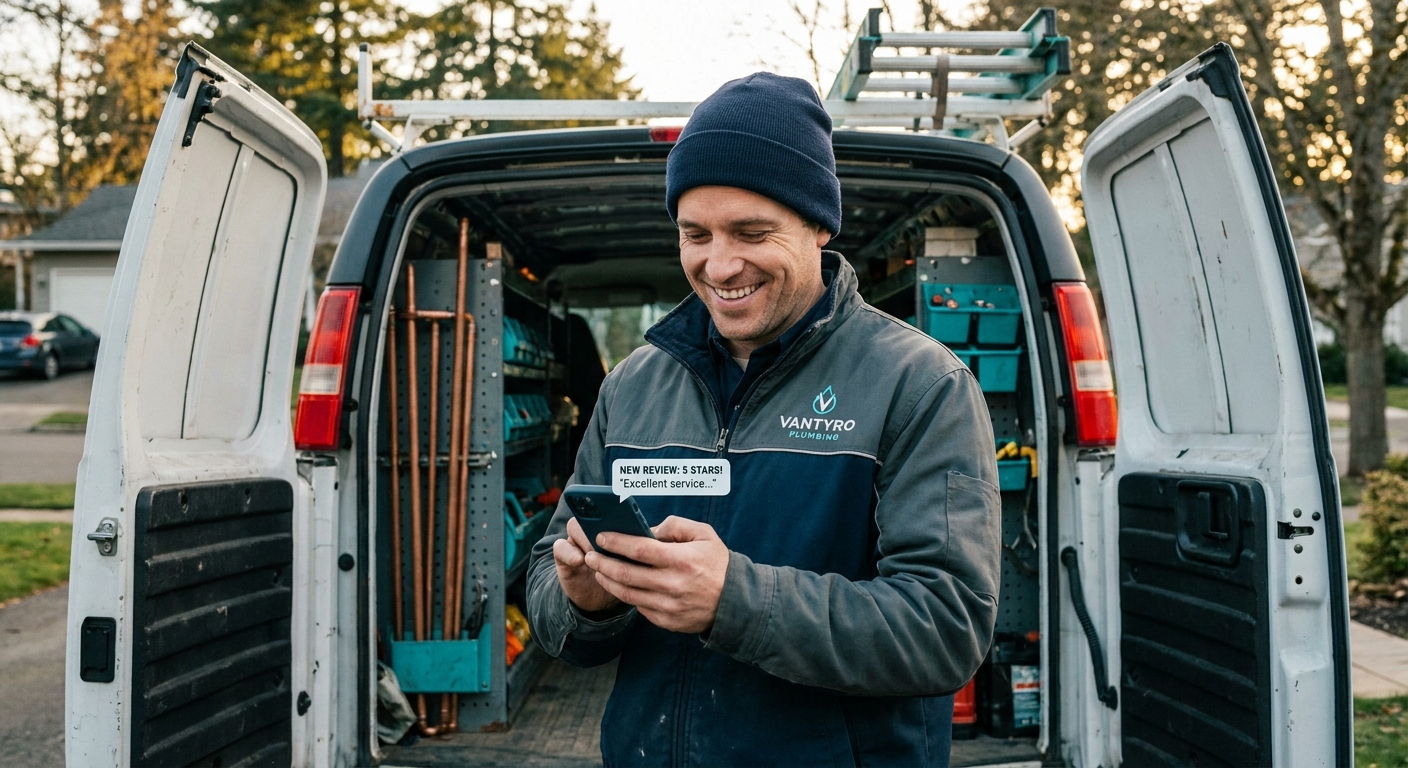
When a job ends, when the customer is happy, the work is done, and the tech is loading up the van, that's the moment. It lasts about ten minutes. The customer is satisfied. They'd give you a good review if you asked. But nobody asks. The moment passes. Three months later, that customer finally leaves a review when they have a complaint. That's how a business doing good work ends up with a 3.8.
The math works against you when the count is low. With fewer than 20 reviews, one unhappy customer can swing your average by a quarter to half a star overnight. It takes 8 to 10 new 4-star or 5-star reviews to recover that ground. Without a system pulling in positive reviews after every job, one bad day can define you for a year.
What 4.5 Stars Actually Gets You
Businesses that go from 3.5 to 4.5 stars see a 25% increase in inbound calls. Not from more ads. Not from a new website. From the same number of people searching, just more of them clicking call instead of clicking back.
If your business takes 40 calls a month today, that's 50. If your average job is worth $600, that's an extra $6,000 a month from the same search traffic you already have.
The math works the other way too. If you're sitting at 3.9 and generating $20,000 a month in revenue, you're leaving roughly $5,000 on the table every month because a third of the people who found you decided not to call. Not because you're bad. Because your number is wrong.
That's what a weak rating actually costs. It's not abstract. It's not "brand perception." It's jobs.
Three Moves That Close the Gap
You can't fix your rating by disputing old reviews. You fix it by volume. Enough new positive reviews and the old ones get buried. The bad ones become a smaller percentage of a bigger number.
The path from 3.9 to 4.5 isn't dramatic. It's repetitive. And it works.
The first move is the hardest to build but the most valuable once it runs. Ask for a review after every completed job: not some jobs, not the easy ones, every one. The ask needs to happen at the right moment, right after the work is done while the customer is still happy. Make it easy: a text with a direct link to your Google review page. One tap. That's it. The businesses that grow their ratings fastest are the ones that make this automatic. Every job closed, a review request goes out. No exceptions, no decisions.
The second move protects you from the worst outcomes. Not every customer is happy. Some will have a complaint. Your choice is to find out about it now, privately, or find out about it after they post a 1-star on Google. Unhappy customers who get a real, quick response from you leave public reviews far less often. A simple follow-up after every job ("How did we do? Any issues?") catches the problems before they go public. That alone defuses most complaints.
The third move is the one almost nobody does. Respond to your reviews. All of them. Every 5-star deserves a brief thank-you. Every 2-star deserves a calm, professional response. When a new customer looks at your Google profile and sees an owner who responds, they trust you more. Google notices it too — active review responses are a local ranking signal. This isn't a maybe. It's documented.
None of these moves require fake reviews. None of them break Google's guidelines. They just make sure the customers who are already happy actually say so, and that unhappy ones get a chance to be handled before they go public.
Getting from 3.9 to 4.5 doesn't take years. With a consistent review request system running after every job, most service businesses see meaningful movement in 30 to 60 days. The rating climbs because the volume of positive reviews climbs. The math works in your favor once the system is running.
Where most businesses stall is consistency. One month they ask, one month they don't. They get a couple of reviews, things feel better, the habit fades. The rating plateaus. Then a bad review comes in and they're back where they started.
A system removes the decision. It runs whether you remember or not. That's the difference between Mike and his competitor with 112 reviews. Not effort. System.
Vantyro's Reputation Engine does exactly this: automatic review requests after every job, private feedback routing for unhappy customers, and automatic review responses. The rating climbs because the process runs.
Every job you don't get because of a low rating is a job your competitor's reviews just won. A Revenue Leak Assessment takes 20 minutes and shows you exactly what your current rating is costing you. Book yours free.
Frequently Asked Questions
- What Google star rating do I need to get hired by most customers?
- 4.5 stars is the threshold that matters in 2026. Data from SkillMammoth shows 31% of consumers refuse to hire a business with a rating below 4.5 stars. Below that number, nearly a third of potential customers rule you out before they read a single review.
- How do I get from 4.0 to 4.5 stars on Google without fake reviews?
- Volume of real reviews is the only reliable path. Ask every satisfied customer for a review right after the job, a text with a direct Google link. Intercept unhappy customers privately before they post publicly. Respond to every review. Do this consistently for 60-90 days and the math moves in your favor. Fake reviews violate Google's guidelines and can get your profile suspended.
- How many Google reviews does a service business need to rank locally?
- There's no magic number, but 50+ reviews gives Google enough signal to rank you with confidence. More importantly, the rating matters as much as the count. A business with 80 reviews at 4.7 stars consistently outperforms a business with 200 reviews at 3.9 stars in local pack results.
- What happens to my inbound calls if I go from 3.5 to 4.5 stars?
- Based on Vantyro's data across service business clients, businesses that move from 3.5 to 4.5 stars see a 25% increase in inbound calls. That lift comes from the same search traffic. More people click call instead of clicking back to find someone else. For a business generating $20,000 a month, that's roughly $5,000 in additional revenue from the same marketing spend.
- How long does it take to improve a Google star rating for a service business?
- Most businesses see measurable movement in 30 to 60 days when they run a consistent review request after every job. The trajectory depends on current volume: a business with 8 reviews will move faster than one with 80. The key is consistency. Sporadic asking produces sporadic results.

Steve Spentzas
Founder, Vantyro
Steve grew up in the trades and spent 20 years managing energy programs at Siemens, CLEAResult, and the Gas Technology Institute before building Vantyro to fix the revenue leaks that cost service businesses real work every day. Read more
See Where Your Business Is Leaking Revenue
Free 20-minute assessment. We map your intake process and show you the exact dollar cost of what you're missing.
Book Your Free Assessment