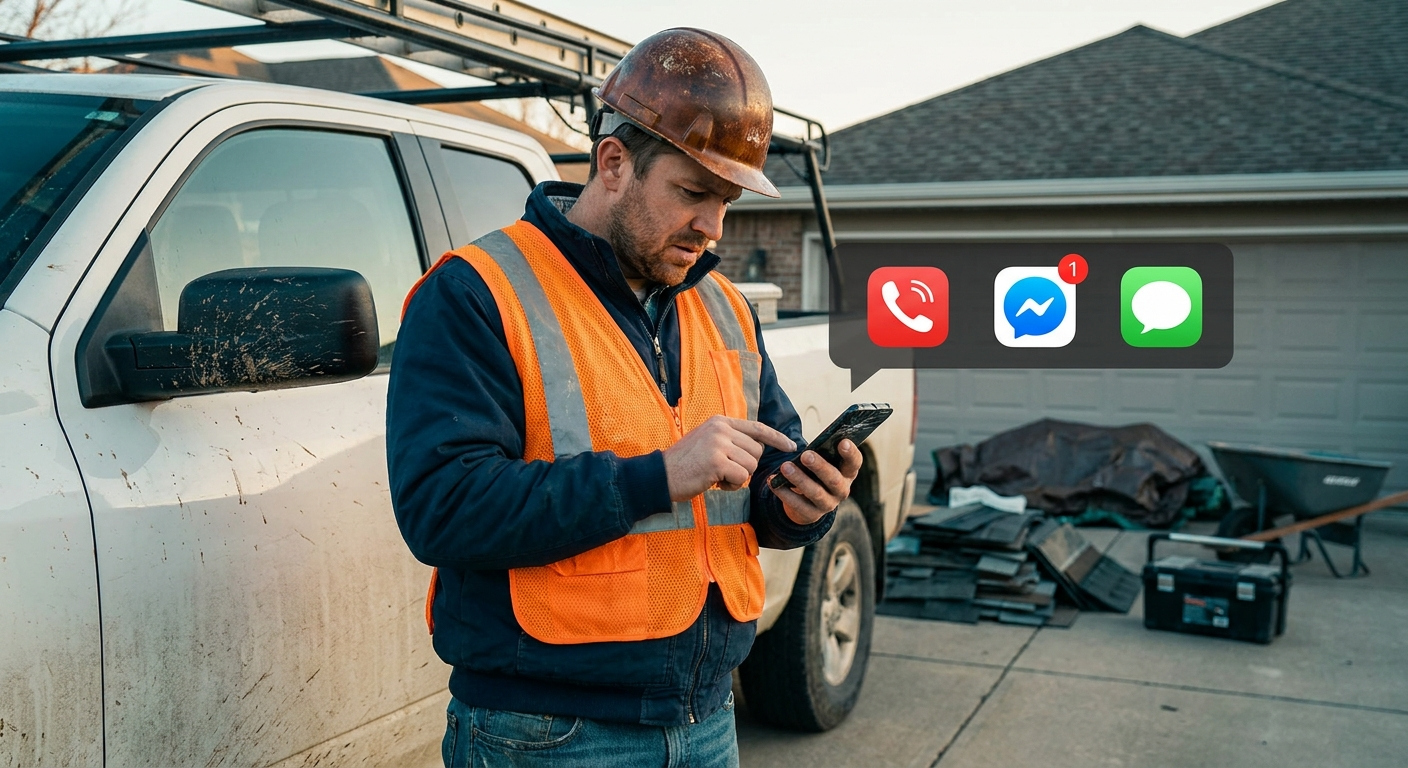
Service Business Missed Messages Are Killing Your Leads — Here's Where They're Going
A roofing company owner messaged a prospect back on Facebook. Three days late. He typed out a full estimate, hit send, and watched the "seen" tick appear. No reply. The homeowner had already hired someone else.
That was a $4,200 job. Gone. Not because the lead was bad. The homeowner was ready to buy. Gone because the message sat in a Facebook inbox nobody was checking while the owner was on a job site.
This happens to service businesses every single day. It's one of the biggest revenue leaks in the industry, and most owners don't even see it. They blame their ads. They blame their website. They blame the season. The real problem is simpler: service business missed messages are losing leads before the conversation ever starts, scattered across so many channels that no one person can watch them all.
The short answer: the average service business runs five or six communication channels at once. Most have no system for monitoring all of them. Leads slip through, competitors answer first, and the job is gone.
Why Are Service Businesses Losing Leads They're Already Getting?
Owners who advertise are often confused when leads don't close. The clicks are there. The calls come in. Forms get submitted. Revenue doesn't follow. So they assume lead quality is the problem and spend more on ads.
That's the wrong diagnosis.
Lead quality is usually fine. The problem is that the first message — a text, a DM, a form submission — never got a fast enough response. Or any response at all.
Harvard Business Review reported that companies responding to leads within an hour were seven times more likely to close the sale than those who waited even one hour longer. For service businesses, where a homeowner is comparing two or three quotes at once, being first to respond often means being the only one who gets a shot.
The leads aren't bad. They're just not being caught.
The 5 Places Where Service Business Messages Go to Die
There are specific channels where messages pile up and go unanswered. Most service businesses operate across all of them with no consistent system for any.
Phone and Voicemail
When you're on a job, your phone rings and you let it go to voicemail. Logical. But most callers who reach voicemail don't leave a message. Of those who do, a large percentage never get a call back the same day. The caller moves on. If a competitor answers live, the job goes there.
Text Message
Texts to the business number go to a personal cell phone. That phone is in a pocket, on a dashboard, sitting on a truck seat. Some messages get seen in five minutes. Others get buried under a dozen other texts and forgotten. No system, no alert, no follow-up when a text goes unanswered past an hour.
Facebook Messenger
Facebook Messenger is where a surprising number of leads land, especially for businesses with an active Facebook presence or local group activity. These messages don't come through the phone's main message app. They sit in a separate inbox that might get checked once a day, if that.
Instagram DMs
Same problem, different app. If a business posts regularly or runs Instagram ads, DMs from interested homeowners come in. Many owners have no set schedule for checking Instagram messages. A lead might sit 48 hours before anyone sees it.
Website Contact Forms
A prospect fills out a form on the website: name, number, what they need. That form sends an email to an address the owner might not check most often. Or it goes into a shared inbox where nobody is clearly responsible for the follow-up. Or it gets buried next to 40 other emails.
What a Single Missed Message Actually Costs
What's your average job value?
For a landscaping company, the average residential job might be $800. For an HVAC company, a service call runs $400 to $600, and a replacement unit is $8,000 to $12,000. For a cleaning company, a recurring client is worth $200 to $300 a month for years.
Think about how many messages go unanswered in a week. Not because anyone meant to ignore them. Just because no system is watching all five channels at once.
Two missed texts and one Facebook DM per week, at a $700 average job value, is more than $100,000 in potential revenue at stake every year. At a 50% close rate, that's still $54,000 that never had a chance. Not from bad leads. From messages nobody saw in time.
That math is what makes this a systems problem, not a marketing problem.
What It Looks Like When Nothing Gets Missed
A unified inbox: one place where every call, text, email, Facebook message, Instagram DM, website chat, and Google Business message lands.
Every message gets seen. Team members can be assigned to respond. Response times are tracked. If a message goes unanswered past a set window, an alert goes out before the lead goes cold.
It's not a new app to check. It's one view that replaces five fragmented ones. The owner stops worrying whether someone got back to that Facebook DM. The system tracks it.
Vantyro's Response Control Center is built for this. One inbox. Every channel. Nothing missed.
Every unanswered text is a job your competitor just won. A Revenue Leak Assessment takes 20 minutes and shows you exactly where messages are getting lost. Book yours free.
Frequently Asked Questions
- How many communication channels does the average service business miss messages on?
- Most service businesses actively receive messages on five to six channels: phone calls, SMS texts, email, Facebook Messenger, Instagram DMs, and website contact forms or chat. Many also receive messages through Google Business. Without a system that consolidates these, it's nearly impossible for one person, or a small team, to monitor all of them consistently.
- What's the most common channel where service businesses lose leads?
- Facebook Messenger is often the most undermonitored. Business owners check it less frequently than their phone, and there's no system alert when a new message arrives unless notifications are enabled and the phone is nearby. Text messages are a close second. They arrive in a personal phone that may be in a pocket on a job site for hours.
- How does a unified inbox work for a small service business?
- A unified inbox connects all your communication channels: phone, text, email, Facebook, Instagram, website chat, Google Business. When a message comes in from any channel, it appears in the same place. You can reply from that one dashboard, assign the message to a team member, and set response-time alerts so nothing sits unanswered.
- How much does a missed text or Facebook message cost a service business?
- It depends on your average job value. A service business with a $700 average job that misses three messages per week has $109,200 in potential revenue at risk each year. At a 50% close rate, that's $54,600 that never had a chance to close. Even one or two missed messages a week adds up to tens of thousands of dollars annually.
- What's the difference between a unified inbox and just checking my phone more often?
- Checking your phone more doesn't fix the problem. It adds stress. A unified inbox gives one person visibility into every channel without opening five separate apps. It creates a record, enables team assignment, and automates follow-up alerts. Checking your phone more means you're always reactive. A unified inbox means nothing escapes the system, whether you're on a job or off the clock.

Steve Spentzas
Founder, Vantyro
Steve grew up in the trades and spent 20 years managing energy programs at Siemens, CLEAResult, and the Gas Technology Institute before building Vantyro to fix the revenue leaks that cost service businesses real work every day. Read more
See Where Your Business Is Leaking Revenue
Free 20-minute assessment. We map your intake process and show you the exact dollar cost of what you're missing.
Book Your Free Assessment