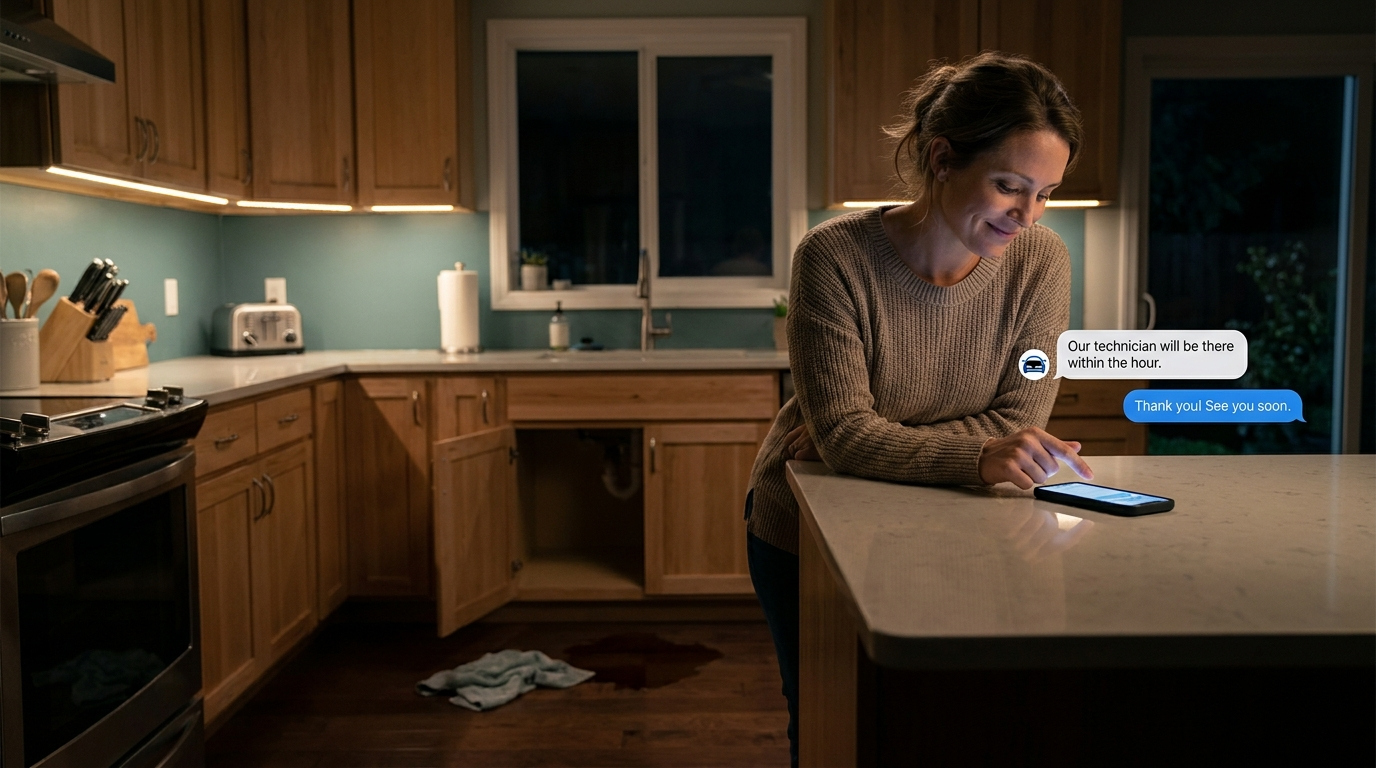
It's 11:47pm on a Tuesday. A homeowner stands in her kitchen with a wet towel under the sink. The cabinet floor is starting to swell. She types "emergency plumber near me" into her phone. Three results pop up. She taps the first one. She reads two sentences, scrolls past a stock photo of a smiling guy in coveralls, finds a contact form, and stops. It asks for her name. Her email. Her address. The type of service. The urgency. A description of the problem. She closes the tab. She tries the second result. Same form. She closes that one too.
She taps the third. A small chat window opens in the corner. It says, "Looks like a late-night problem. Want me to send a tech tonight, or would tomorrow morning work?"
She types: "Tonight if possible."
By 11:51pm she has a confirmed visit window for 7am, a quote range, and a text on her phone with the tech's name. The plumber whose website she landed on is asleep. He'll see the booking when he wakes up. The job will run him about $3,200. He didn't lift a finger.
That's a website chatbot for a service business doing the one thing a contact form can't do. Answering when a stranger has a problem and a credit card and twelve minutes of patience.
What a Website Chatbot Actually Does (And Why Forms Lose)
A website chatbot is a small chat window that opens when someone lands on your site. It greets them. It asks what they need. It either answers the question or collects enough to book a visit. The good ones can pull from your service list, check availability, and drop the lead straight into your calendar.
The reason it works is mechanical, not magical. A contact form makes the visitor do all the work upfront. They don't know if you'll respond in five minutes or five days. They don't know if they're filling out the right form. They don't know what it'll cost. So they bail.
A chatbot flips the load. The bot does the asking. It answers the most common question (cost? availability? do you service my zip?) before the visitor has to ask. By the time it requests a name and a number, the visitor has already gotten value from the chat.
The numbers back this up. A 2025-2026 industry analysis found that chat-to-conversion rates run 10 to 20 percent across categories. Traditional contact forms convert at 2 to 3 percent. One research review of online shoppers found that visitors who engaged with a chat tool converted at 12.3 percent. Visitors who didn't engage converted at 3.1 percent. About a four-times lift.
For a service business, the same shape holds. A site that converts 1 percent of its traffic into a lead can move to 3 percent with a chat layer running. That triples the lead count. No new visitors. No new ad spend.
The Night Shift You're Not Working
Here's the part most service business owners haven't run the numbers on. Your website doesn't sleep. Your phone does.
A meaningful share of traffic to a typical home-services site lands outside business hours. Evenings. Weekends. The long quiet of 10pm to 6am. That's when the leaking sink starts. The AC stops. The garage door refuses to close. People search. They land on your site. They want help right then.
If your only options on that page are a phone number that goes to voicemail and a contact form that lands in an inbox you'll see in nine hours, you've already lost the lead. The next site they tap will get the booking. A 2026 customer-service study reported that 72 percent of customers now expect immediate service around the clock. They treat slow response as a real reason to pick someone else.
The chatbot is the part of your sales process that works the night shift without you. It catches the visitor at the moment of pain. A few short questions later, the slot is booked. You read it with your morning coffee.
I get it. Most owners I talk to already know they're losing leads after hours. They just haven't had time to fix it. When you're the one running the truck and the books, the website gets pushed to next month. The Vantyro benchmark for missed-call cost runs about $72,000 a year for the average service business. The after-hours website leak sits next to it, in the same column of the ledger, mostly invisible. Most owners never run the math. The lost lead never showed up in their inbox. It just clicked away.
What a Good One Says, and What a Bad One Says
Not every chatbot is the same. Most are bad. The bad ones open with "Hi! How can I help you today?" — the digital greeter at a hardware store. They lead with their own menu, not the visitor's problem. They feel like a form pretending to be a conversation.
A good chatbot for a service business sounds like a dispatcher, not a marketer. Short questions. Plain words. "What's broken?" "How long has it been doing this?" "Do you need someone tonight, or is the morning okay?" That's the voice of someone who's solved this exact problem before.
It also has to know what your business actually does. If you don't service a zip, the bot says so in its first reply. It doesn't take the visitor through five questions before telling them you're an hour outside their area. If a job sounds like a warranty claim, it routes them to your warranty queue. If it's a cash emergency, it offers a slot.
The handoff matters as much as the chat. The visitor gets a real confirmation. A name. A window. A number to text if something changes. Your team gets the same record on their phone. Nothing falls through the gap between the website and the calendar.
A chatbot that does that work turns a static brochure site into something that earns its keep at 2am. A chatbot that doesn't is just another widget your visitors close.
How a Service Business Should Decide Whether to Add One
Let me show you the system. Open your site analytics for the last 30 days. Find two figures: total visitors, and total leads. Calls, form fills, booked jobs. Divide one by the other.
If your site is converting under 2 percent of traffic into anything trackable, a chat layer is not optional. You're paying for the traffic. Through Google. Through ads. Through word of mouth. And you're walking away from the back end of it. The fix is mechanical, not creative. The chat that books the job at midnight is the same chat that books it at noon.
If your site is converting at 5 percent or higher, you're already running a tight funnel. The chatbot's lift is smaller. The after-hours capture still pays. The visitor who lands at 11pm doesn't care how good your funnel is in the daytime.
The question is never whether the chatbot is the smartest tool on your website. The question is simpler. Does the visitor at 11:47pm have anywhere to go besides closing the tab? If the answer is no, that visitor isn't a lost click. They're a job your competitor will run on Wednesday morning.
The fix is real. It's small. It doesn't require hiring anyone. Learn how the Vantyro Website Chatbot works.
Every night your website's chat window stays dark, a job gets booked by the next business on the list. A Revenue Leak Assessment takes 20 minutes. It shows you exactly what your after-hours traffic is worth. Book yours free.
Frequently Asked Questions
- Does a website chatbot actually book real jobs for service businesses?
- Yes, when it's set up to do more than answer questions. A chatbot built for a service business should be able to confirm service area, capture the problem in plain words, offer a real time window, and drop the booking into your scheduling system. The conversion lift comes from removing the wait between "I need help" and "someone is coming."
- How much does a website chatbot improve conversion rate compared to a contact form?
- Industry data from 2025-2026 puts chat-to-conversion rates between 10 and 20 percent. Traditional forms convert at 2 to 3 percent. About a four-times lift on average. The exact number depends on your traffic and how the chatbot is built. For most service businesses with under 5 percent site conversion, a chat layer is the single fastest way to move that figure.
- What does a chatbot say to a visitor at 2am that a contact form can't?
- A form can only collect. A chatbot can answer. It can confirm "yes, we cover your zip." It can tell the visitor a tech can be there by 7am. It can give a rough cost range and book the slot, all in under three minutes. A contact form sits silent until you check it the next morning. By then the visitor has called the next business in the search results.
- Will a chatbot annoy my customers or make my business look cheap?
- Only the bad ones do that. The bad ones pop up too fast, lead with a long greeting, and feel like a hard sell. A good chatbot waits a beat, opens with a useful question, and lets the visitor leave easily if they want a phone number instead. Done well, a chat window reads like a quick text exchange. Most people are used to that by now.
- Can a chatbot book appointments directly on my calendar?
- Yes. A chatbot built for a service business should connect to whatever you already use to schedule. Google Calendar. Your CRM. Your dispatch system. The booked slot shows up where your team already looks. If a chatbot can't do that, it's a lead-collector, not a booking system. The gap between the two is where most leads die.

Steve Spentzas
Founder, Vantyro
Steve grew up in the trades and spent 20 years managing energy programs at Siemens, CLEAResult, and the Gas Technology Institute before building Vantyro to fix the revenue leaks that cost service businesses real work every day. Read more
See Where Your Business Is Leaking Revenue
Free 20-minute assessment. We map your intake process and show you the exact dollar cost of what you're missing.
Book Your Free Assessment